Tag Archives: society

At the Heart of the Matter

The actress Goldie Hawn won her only Oscar for her role in the movie Cactus Flower, and it came at a young age and early in her acting career. Goldie played a ditzy young woman (a most logical casting from her acting in the Laugh-In TV series), but the character was complex and brilliantly played, because underneath that seemingly simple surface was a complex personality with a big trusting heart, and grounded in her own sense of treating others well.

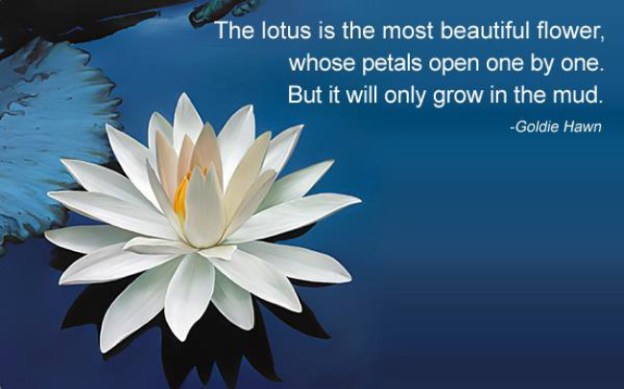
“The lotus is the most beautiful flower, whose petals open one by one. But It will only grow in the mud.” Both her role as Toni Simmons in Cactus Flower, and this quote by the real-life Goldie, speak volumes about not “judging a book by its cover”. What kind of heart beats beneath the cover?

Perhaps our world would be a much better place if that one question was the way we primarily navigated our way through it, rather than “how much money do you make, how big is your house, what’s your status?…” It’s a shift from a societal matrix barometer to a feeling human one.

More quotes from Goldie Hawn:

“The key is to learn to respect and honor the complications of other people’s lives”

“It is the simplest things in life that hold the most wonder; the color of the sea, the sand between your toes, the laughter of a child.”

The only thing that will make you happy is being happy with who you are, and not who people think you are.”

“Wonder shows in the light of our eyes. Without it, they become dull and old.”

“You know that feeling just before you’re going to laugh? That thing where you get all bubbled up?… It’s like a bubble of laughter, but it hasn’t come out yet…?
That’s what God feels like.
It’s a feeling of joy and love and well-being.”


Susan L Hart 2023  / HartInspirations.com

Please subscribe here if you’d like to receive my monthly newsletter.

The Spirit of Aloha

Hawaii is one of the major tourist spots in the world and if you spend all of your time in Honolulu and Waikiki, a tourist experience is exactly what you will have. Waikiki Beach is just one and one-half miles long and this small strip of sand attracts millions of foreign visitors each year.

However, when you travel outside of the blatantly tourist areas, you begin to discover another Hawaii. You find islands of breathtaking tropical beauty, a slower speed of living, a quiet grace, and inevitably you are introduced to the spirit of “aloha”. If you dig even deeper beneath the surface, you also learn of an issue that runs deep in the hearts of the Hawaiian people. This is the issue of sovereignty and freedom.

First, it is important to understand the concept of aloha. At a very basic level aloha means hello and goodbye, however this one simple word runs much deeper than these superficial meanings. In the Hawaiian culture, words have mana (pronounced: mah’ nah, meaning spiritual or divine power), and aloha is among the most sacred. Aloha is a divine word and it is a greeting of love when expressed with sincerity.

To introduce you to the basic background of the sovereignty issue in Hawaii, here is a quote from an article called “Hawaiian Sovereignty and the Native Hawaiian Vote”. Ppkp Laenui, who at the time was Director of the Institute for the Advancement of Hawaiian Affairs, wrote this in October of 1996:

“There is another side to the picture postcard of the hula girl swaying in her grass skirt under the coconut tree with the American flag in the background. It is the picture of a proud, hard working, intelligent, and honest Hawaiian people whose ancestors crisscrossed the Pacific ocean long before Columbus came upon the Americas, whose literacy rate was at one time the highest in the world, whose nation had almost a hundred diplomatic and counselor posts around the world, whose leaders signed treaties and conventions with a multitude of states of the world, and whose King was the first Head of State to circle the globe traveling to America, Asia, and Europe before returning to Hawai’i.

“In five quick years, Hawai’i moved from independent nation/state to a colony of the United States of America. Following an armed invasion in 1893, by 1898, the U.S. claimed Hawai’i, without the consent of its constitutional monarchy or the Hawaiian nationals. For a time, Hawai’i was lost from the arena of international presence other than as a historical footnote.

“In 1946, the General Assembly of the United Nations through Resolution 66(I) noted Hawai’i as one of seven territories over which the United States was to administer pursuant to Article 73 of the U.N. Charter. By 1959, Hawai’i was removed from that status and considered a State of the U.S. The process under which this changed status happened is now under serious scrutiny for its failure to meet basic standards of self-determination.” 1.

In that same fateful year, on May 20, 1959, a baby called Israel Kamakawiwo’ole (nicknamed “IZ”) was born on the small island of Oahu, Hawaii. He was raised with the knowledge of his Polynesian heritage, found the music inside, and eventually wrote songs that lamented the destruction of the land and the loss of sovereignty among the Hawaiian people. He gave voice to a desire to take back the land that was stolen from the Hawaiians. So say some of the words from IZ’s song “Hawaii ’78”:

“Cry for the gods, cry for the people
Cry for the land that was taken away
And yet you find Hawai’i.”

Sadly, IZ passed away on June 26, 1997, while his star was still on the rise. However, the words of this musical icon had already captured the admiration and imagination of thousands of followers, as it continues to do even today.

The issue of sovereignty in some ways seems complicated, and yet it is simple. It is has now existed in Hawaii for over one hundred years, and many people there debate whether the land will ever be returned to the native Polynesian people. No matter what the future holds, however, a love for the land will always be held in the hearts of the Polynesian people, as well as anyone else that settles there and understands and lives the spirit of aloha.

The music of IZ is haunting and compelling. He speaks to the souls of not only the Hawaiian people who had their land stolen, but at a deeper level to anyone who has felt the bite of injustice and control. (That would probably be most of us, at some time and in some way in each of our lives). The music of IZ cries out for a return to the principle of Aloha, so that we may connect back to the beautiful spirit of the land living deep within the soul of each of us.


Footnotes:

1. Quotation from “Hawaiian Sovereignty and the Native Hawaiian Vote”, October 1996, by Ppkp Laenui.

2. Quotation from “Hawaii ’78” on “Facing Future” album, by Israel Kamakawiwo’ole, 1993 BigBoy Record Company


© Susan L Hart 2023  /  HartInspirations.com

Please subscribe here if you’d like to receive my monthly newsletter.

The Importance of Imagination

Do you use the power of imagination to to create and expand your life? If not, you are not alone. Although right-brained creative thinking does come naturally to some people, it does not to others.

Personally I think our educations systems need an overhaul. We are taught “known knowledge” and we’re expected to regurgitate it by rote. There is some value in that, but it is also very limiting to the innate potential of our human consciousness.

What if part of our education from a very young age was geared towards developing our imagination and creative thinking skills? New inventions and solutions to existing problems require creative thinking. Our world is really in need of more creativity right now, not more “by rote”.

If you feel that your brain is too locked down in “what is” and you’re not giving any time to “what could be”, here is a good article with 10 tips on how to get your creative mind percolating:

10 Ways to Boost Your Imagination and Achieve Big Things

Inspirational Quotes:

“I am enough of an artist to draw freely upon my imagination. Imagination is more important than knowledge. Knowledge is limited. Imagination circles the world.
~ Albert Einstein

“Everything you can imagine is real.”
~ Pablo Picasso

“Logic will get you from A to Z; imagination will get you everywhere.”
~ Albert Einstein

“If you don’t imagine, nothing ever happens at all.”
~ John Green,

“You must give everything to make your life as beautiful as the dreams that dance in your imagination.”


Susan L Hart | HartInspirations.com

Please subscribe here if you’d like to receive my monthly newsletter.

What Kind of Utopia?

“We shall meet in the place where there is no darkness.” ~ George Orwell, 1984

George Orwell’s quote begs the question, is there a such a place of no darkness in this 3rd-dimensional Earth plane? History has shown that it has always existed, and so we might extrapolate that it likely always will to one degree or another. After all, challenge appears to be a crucial factor in sparking self-illumination in humans, and is that not why our souls choose to have an experience of life in a human body on this planet? To grow?

I’ve tried to imagine what life would be like if we had no challenge, and, is that how we would define utopia? It would be pretty darned boring, I think. Having said that, I also think that human beings at this time are being weighted by too many unnecessary obstacles, and much of it is rooted in a choke hold of governmental overreach. It’s feeling to me like we’re moving towards the type of dystopia Orwell wrote about.

Somehow the rules that were meant to organize and make a functioning and safe society have morphed into a monster, one that thinks it has the right to completely control our lives. It increasingly behaves as thought it owns us. Ask yourself, were you born onto this planet to be owned by an entity?

The whole point of George Orwell’s dystopian novel 1984 was to present to the reader a vision of a kind of world that we may not want. Do we? Or, don’t we? Human life (I think) will never be without challenge. But how do we envision a kind of “utopia” that is gentler and nurturing, and yet still involves enough challenge that we are energized by it, that still provides the impetus to grow? Why is our growth contingent on so much darkness? There must be a different way. I believe it is something that we have never known yet on this planet.

This may be our greatest challenge of all right now: To open our minds enough to allow for something completely new and different, not just an overhaul or cosmetic change of what we have always known. We are completely capable of creating a new reality, but only if we see what society is right now, and free ourselves enough to move beyond it.


Hartinspirations.com  |  My ebooks

Threshold of Your Mind

230403

The most effective mentors in my life taught me by their example, while not treating me as inferior at along the way. They “led me to the threshold of my mind”. There was always a sort of flow, a reciprocal give and take of learning and teaching between us that was enjoyable. Those relationships have tended to last.

There have been other teachers where there was a sort of ego thing going on; they clearly wanted me to “stay in my place” as a student. This sort of relationship starts to chafe after a while. At a certain point, in spite of being grateful for the learning, there was no real space for me in the relationship any more. I had to move on.

What has been your experience with mentors?

Hartinspirations.com  |  My ebooks