Tag Archives: humanity

Melding

Everything fades to dust
eventually,
the wheels of progress turn
inevitably.

The elders of the tribe
woefully,
remember times not lived
respectfully.

History hides secrets
illicitly,
of the big lessons doled
cruelly.

The past is only known
truthfully,
by the ones who lived it
successfully.

If young people listened
graciously,
to the old wisdom learned
painfully,

together they could build
splendidly,
a new vision that’s forged
lovingly.


Melding is an excerpt from Humanity’s Lament: Poetry for Our Times. It’s free here.


Melding builds on yesterday’s post about Great-Aunt Nelly and her gumption. There was advice she gave me many years ago, and through my arrogant youthful eyes, I assumed she was a lady (although very nice) that could not know a whole lot about the subject we were discussing. After all, she had never married, so how could she? A whole lot, as it turns out. I should have listened better!

Although I grew up in an era where we were taught to respect our elders (and I did), we weren’t necessarily good at appreciating their wisdom. Perhaps given the state of our world, we should be embracing the wisdom of our elders. Real change, I believe, could be better accomplished with a broader inter-generational perspective, accomplished through conversation, cooperation, and intentional action.


The Spirit of Aloha

Hawaii is one of the major tourist spots in the world and if you spend all of your time in Honolulu and Waikiki, a tourist experience is exactly what you will have. Waikiki Beach is just one and one-half miles long and this small strip of sand attracts millions of foreign visitors each year.

However, when you travel outside of the blatantly tourist areas, you begin to discover another Hawaii. You find islands of breathtaking tropical beauty, a slower speed of living, a quiet grace, and inevitably you are introduced to the spirit of “aloha”. If you dig even deeper beneath the surface, you also learn of an issue that runs deep in the hearts of the Hawaiian people. This is the issue of sovereignty and freedom.

First, it is important to understand the concept of aloha. At a very basic level aloha means hello and goodbye, however this one simple word runs much deeper than these superficial meanings. In the Hawaiian culture, words have mana (pronounced: mah’ nah, meaning spiritual or divine power), and aloha is among the most sacred. Aloha is a divine word and it is a greeting of love when expressed with sincerity.

To introduce you to the basic background of the sovereignty issue in Hawaii, here is a quote from an article called “Hawaiian Sovereignty and the Native Hawaiian Vote”. Ppkp Laenui, who at the time was Director of the Institute for the Advancement of Hawaiian Affairs, wrote this in October of 1996:

“There is another side to the picture postcard of the hula girl swaying in her grass skirt under the coconut tree with the American flag in the background. It is the picture of a proud, hard working, intelligent, and honest Hawaiian people whose ancestors crisscrossed the Pacific ocean long before Columbus came upon the Americas, whose literacy rate was at one time the highest in the world, whose nation had almost a hundred diplomatic and counselor posts around the world, whose leaders signed treaties and conventions with a multitude of states of the world, and whose King was the first Head of State to circle the globe traveling to America, Asia, and Europe before returning to Hawai’i.

“In five quick years, Hawai’i moved from independent nation/state to a colony of the United States of America. Following an armed invasion in 1893, by 1898, the U.S. claimed Hawai’i, without the consent of its constitutional monarchy or the Hawaiian nationals. For a time, Hawai’i was lost from the arena of international presence other than as a historical footnote.

“In 1946, the General Assembly of the United Nations through Resolution 66(I) noted Hawai’i as one of seven territories over which the United States was to administer pursuant to Article 73 of the U.N. Charter. By 1959, Hawai’i was removed from that status and considered a State of the U.S. The process under which this changed status happened is now under serious scrutiny for its failure to meet basic standards of self-determination.” 1.

In that same fateful year, on May 20, 1959, a baby called Israel Kamakawiwo’ole (nicknamed “IZ”) was born on the small island of Oahu, Hawaii. He was raised with the knowledge of his Polynesian heritage, found the music inside, and eventually wrote songs that lamented the destruction of the land and the loss of sovereignty of the Hawaiian people. He gave voice to a desire to take back the land that was stolen from the Hawaiians. So say some of the words from IZ’s song “Hawaii ’78”:

“Cry for the gods, cry for the people
Cry for the land that was taken away
And yet you find Hawai’i.”

Sadly, IZ passed away on June 26, 1997, while his star was still on the rise. However, the words of this musical icon had already captured the admiration and imagination of thousands of followers, as it continues to do even today.

The issue of sovereignty in some ways seems complicated, and yet it is simple. It is has now existed in Hawaii for over one hundred years, and many people there still debate whether the land will be returned to the native Polynesian people. No matter what the future holds, however, a love for the land will always be held in the hearts of the native Hawaiians, as well as anyone else that settles there and understands and lives the spirit of aloha.

The music of IZ is haunting and compelling. He speaks to the souls of not only the Hawaiian people who had their land stolen, but at a deeper level to anyone who has felt the bite of injustice and control. (That would probably be most of us, at some time and in some way in each of our lives). The music of IZ cries out for a return to the principle of aloha, so that we may connect back to the beautiful spirit of the land living deep within the soul of each of us.


Footnotes:

1. Quotation from “Hawaiian Sovereignty and the Native Hawaiian Vote”, October 1996, by Ppkp Laenui.

2. Quotation from “Hawaii ’78” on “Facing Future” album, by Israel Kamakawiwo’ole, 1993 BigBoy Record Company


I wrote this article almost 25 years ago when I visited Hawaii. It seems apropos to repost it again, given the issues of land ownership and sovereignty that are emerging in the world right now.


© Susan L Hart 2025

Today

This morning I woke up thinking about sunrises and sunsets – not necessarily how many I have enjoyed, mind you, but more so how many I have missed – followed by the “requisite regret”. There was quite a bit of negativity built into that first thought of the day. I quickly self-observed and adjusted accordingly, but in the stress of our modern day life, how often are we waking up with anything but thoughts of what to do, how little time we have to do it (time to watch the sun rise? Hah!), and all the problems associated with getting our ducks in a row and making ends meet.

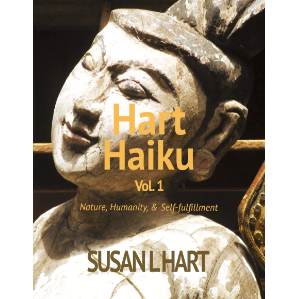
I dipped into my Hart Haiku collection to write today’s post, and decided that “Today” was the perfect one. Have you – did you – give your mind time to formulate the correct thoughts to bring good to you today? Those first thoughts may be the most important work we do each and every day. They set the tone and our intention for our lives. Once we have developed the habit, it is no longer work to think positively. It simply becomes who we are. I don’t know about you, but I obviously still have some work to do in this area…

I’m wishing for you a wonderful day full of good thoughts, and hence, good things. 


Note: This was a repost from June 16, 2023. It was apropos, because today one of our cats got me up at 4:45, needing attention. She is a young kitten, so a baby, and the main job of babies by definition is to deprive adults of sleep. Lol Anyway, after I took care her needs, my urge was to fit in some work before breakfast, but I think I already spend too much time on the computer. Why start the day with eye-ball burnout?

So I gave myself time to just BE, and play with Shadow, and enjoy a gentle start to the day. Some ideas came to me for some new writing, and it was wonderful. I let Shadow pull me softly into the day, instead of pushing myself harshly headlong into it. (And oh yes, I enjoyed the sunrise, too!) Later as I searched my archives, I found the original post “Today”. A perfect fit. Apparently I am still learning – my work inclination is still strong – but I’m making progress…

And so once again, I wish for you a wonderful day, today. 🙂

Start of a new day.
Have you given your thoughts space
to bring good to you?

© Susan L Hart 2025

Earth School

Do you believe your soul is returning here in various lives to work out all that you need to learn to evolve? Or, are you a person who perhaps believes in only one life, but also the eternal aspect of the soul after that one life? Or, are you someone who does not believe in either; there is one life and no afterlife?

I’m not here to say what is “right or wrong”, or what someone else “should or shouldn’t” believe, but only to share my own process on this idea of the evolving soul.

From a very young age, I always felt within me the presence of a higher creative power at work in the world. (If you’re sensitive, you can feel it between the lines in everything. The Native peoples call this “the web of life”.) However, exploring my feeling of this higher energy within the Christian church as a child, and again later as an adult, did not satisfy within me a suspicion that we need way more than one life to encompass all the learning a soul needs to perfect and move back to the One. I also could not accept the idea of a punishing God. (What truly loving being “punishes”?) I also could not accept the idea that such a God would dole out a life of poverty and strife to one person, while giving another a life of relative ease and wealth.

I think we have various experiences, over as many lifetimes as we need, to learn the important principles that various spiritual masters have come here to teach us. And, within each life we, and only we, are responsible for our choices, and the outcome of our lessons. (Taking responsibility eliminates the victim mentality and blame.) Ofttimes we also have other souls that will return to us again within several lives, different bodies playing different roles, so that we can work out our lessons together.

Religious institutions, although they play a role of bringing people together to explore spirituality, can also be one of the great dividers in society. What religion who is truly oriented to nurturing a spiritually evolved society, would condone or promote hatred of another? There are many paths to becoming spiritually evolved, and should we not be simply all helping each other on that path, if the positive evolution of humanity is indeed the common goal?

Eternally

We don’t remember
our other soul lives spent here,
alien Earth plane.

Swaths of sand smooth and
soften hard edges of lost
civilizations.

We visit, then with
infinite impermanence,
return to dust too.


Soul Mate

Eternal surprise,
all the hellos and goodbyes,
right there in your eyes.


Eternal Rhythm

The golden leaves fall,
fearing not the decay of
a coming winter.

Death is essential
to the renewal of life –
All will spring again.

If each in nature
can feel this simple rhythm,
so can humans too.

Why do we resist?
Our fears overshadow the
truth of our being.

But the fall leaves know,
they show us that we too will
green the tree anew.


© Susan L Hart 2025 Soul Journey is a free read.

Read it online, or download the PDF here.

The Day Humanity Decided

An excerpt from The Day Humanity Decided:

This tree exuded a demeanor relentlessly proud. In a strange way, the tree gave the people a feeling of hope that there was something beyond smallness. Over many generations, small had become quite wearisome. It was boring, and well, small. Of course it was against the rules to think about anything outside of small, so it was best to keep those feelings to one’s self.

The biggest problem with the tree (for Tyrannicus) was, of course, that it was altogether contrary to The Rule of Small. Here was an object that defied The Tyrannicus Rex Official History of The Land of Small (kept in a special hall, separate from The Tyrannicus Rex Family Record Book for safe keeping), which stated that everything in The Land of Small had always been small, and in fact, small was the most natural thing in the world. What other way could or should it be? If the history books said it was so, then it must be so.

The narrative of small may have stuck ad infinitum, except for that darned tree. For reasons Tyrannicus could not fathom, more and more the people were beginning to question it. If everything had always been small, and it was natural to be small, then why was that mysterious huge tree in the middle of the square? Where did it come from?

It was not man-made; it was a tree for heaven’s sake, and a tree (being of Nature) was about as natural as you could get. Beyond that, why were the Tyrannicus Rexes so obsessed with removing it? Secretly The People of the Land of Small loved that sad, big tree, so it did raise questions.

To say that this whole situation was very irritating to Tyrannicus would be a massive understatement. He just wanted to live the easy life, but when the people questioned, this required making up new rules. Rules took time to make and enforce, but what else was one to do? It was exhausting, really.

Tyrannicus decided to delegate some of the rule making work. At first it started small, just a couple of people to oversee The Records of Rules of the Land of Small. They’d come to work and pore over the existing records, and then they’d put their heads together to suggest some new rules for the King to edict.

He was very pleased with their work. What he noticed right away was that as The Committee of Rules for the Land of Small made up new rules, it was pretty much impossible to publish them daily. The People of the Land of Small would dutifully wait for the next proclamations, but if they happened to miss an announcement and accidentally break a new rule, it wasn’t his fault, was it?

He hired more rule advisors, and rule making took on a life of its own in the kingdom. The people were now more fearful, which worked in Tyrannicus’s favor. They were so preoccupied trying to keep track of the new rules and the fines they might get if they broke them, they almost stopped thinking about the big tree in the square. Almost… but Tyrannicus would soon discover that in another part of The Land of Small, Nature was conspiring against him…


This has been an excerpt from The Day Humanity Decided. It’s a free download as both PDF and EPUB in my ebookstore. Here is the link.

Or if you just want to read the PDF online, try this link.